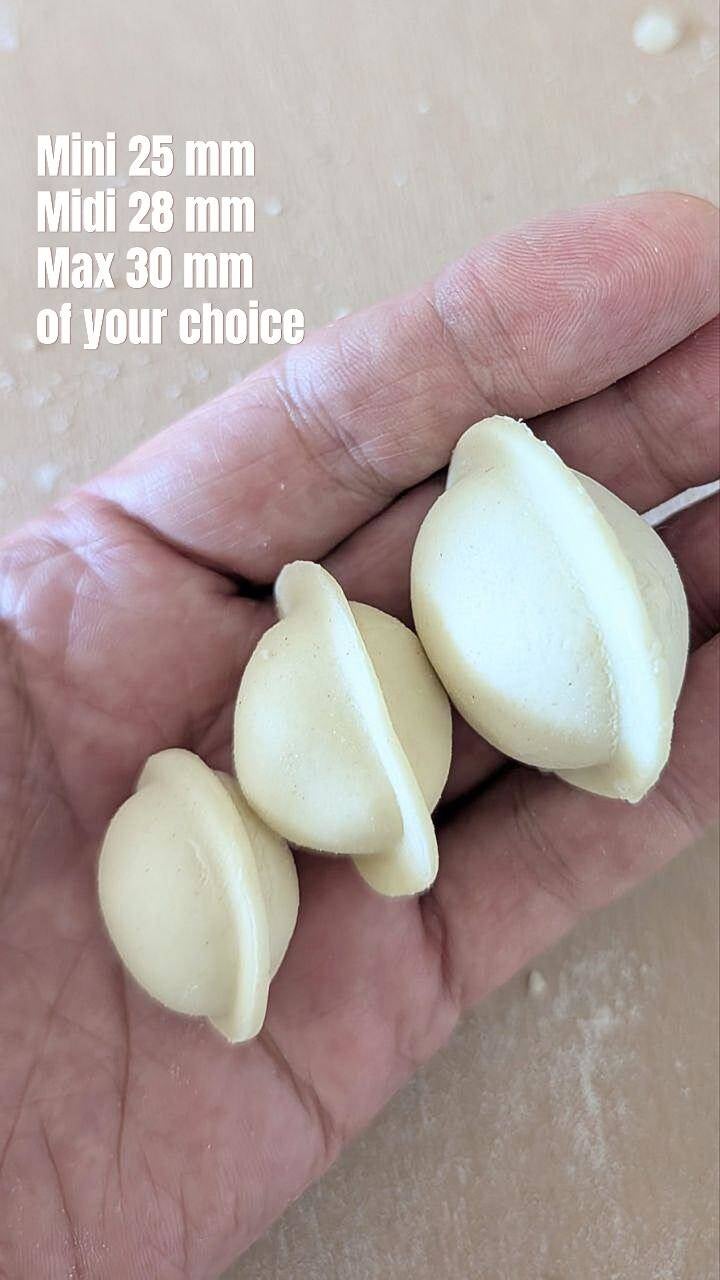
Why Double-Sided Dumplings Are the Original Shape
When people think of homemade dumplings today, they often imagine one familiar shape: a decorative top and a perfectly flat bottom.
Millions of dumplings have been made this way for decades.
Most people assume this is the traditional form.
But history tells a different story.
Traditional Dumplings Were Never Flat
For centuries, dumplings were made entirely by hand.
Whether they were pelmeni, pierogi, jiaozi, mandu, or many other regional varieties, handmade dumplings naturally developed a rounded shape.
The filling sat in the center, surrounded evenly by dough, creating a smooth, slightly domed surface on both sides.
This wasn't a design choice.
It was simply the natural result of handmade craftsmanship.
Why Did Flat-Bottom Dumplings Become So Common?
The answer is surprisingly simple.
During the twentieth century, metal household dumpling molds became extremely popular because they allowed people to make many dumplings at once.
These molds worked by pressing dough into a flat metal plate.
As a result, every dumpling had:
- a decorative upper side,
- but a completely flat bottom.
It was a practical engineering solution that made production faster.
Over time, people became so accustomed to this appearance that many started believing it was the traditional shape.
In reality, it was simply a limitation of the tools.
Bringing the Traditional Shape Back
At JP Mini Midi Max, we asked a simple question:
What if modern technology could recreate the original handmade shape?
Instead of copying traditional metal molds, we designed an entirely new generation of dumpling makers.
Our tools shape the dough from both sides, allowing each dumpling to keep its natural rounded form while still being produced quickly and consistently.
The result is what we call:
Perfect Double-Sided Dumplings.
Not a new invention.
A return to tradition.
More Than Beautiful
The rounded shape is not only visually appealing.
It also offers practical advantages.
Because the filling remains centered and evenly surrounded by dough, every dumpling has:
- a balanced appearance,
- consistent filling distribution,
- even cooking,
- and a premium handmade look.
Whether served fresh, boiled, frozen or cooked later, the dumplings retain the character of traditional handmade food.
Traditional Shape. Modern Technology.
Developing this system required completely rethinking how dumplings are formed.
Rather than adapting old designs, we created new mechanisms that combine traditional appearance with modern efficiency.
Every JP Mini Midi Max product follows the same philosophy:
- preserve the authentic shape,
- simplify the process,
- maintain consistent quality.
From Home Kitchen to Small Production
Our product family is built around the same technology.
Whether you are preparing dinner for your family or making hundreds of dumplings for customers, the principle remains the same.
DM Series
Simple one-press dumpling makers for everyday home cooking.
Fan Mini
Compact rolling dumpling maker for families who prepare dumplings regularly.
Junior Series
Continuous production for enthusiastic home cooks and small businesses.
AdvancedPress
High-performance dumpling maker designed for restaurants and small food production while preserving the traditional rounded shape.
Preserving Tradition Through Innovation
Innovation does not always mean changing tradition.
Sometimes it means understanding it better.
At JP Mini Midi Max, our goal has never been to reinvent the dumpling.
Our goal is to preserve its authentic shape while making it easier than ever to create.
Because the best traditions deserve the best technology.
Discover the JP Mini Midi Max Collection
Explore our complete range of dumpling makers and experience the return of the traditional double-sided dumpling.
Traditional Shape. Modern Technology.
Add comment
Comments